


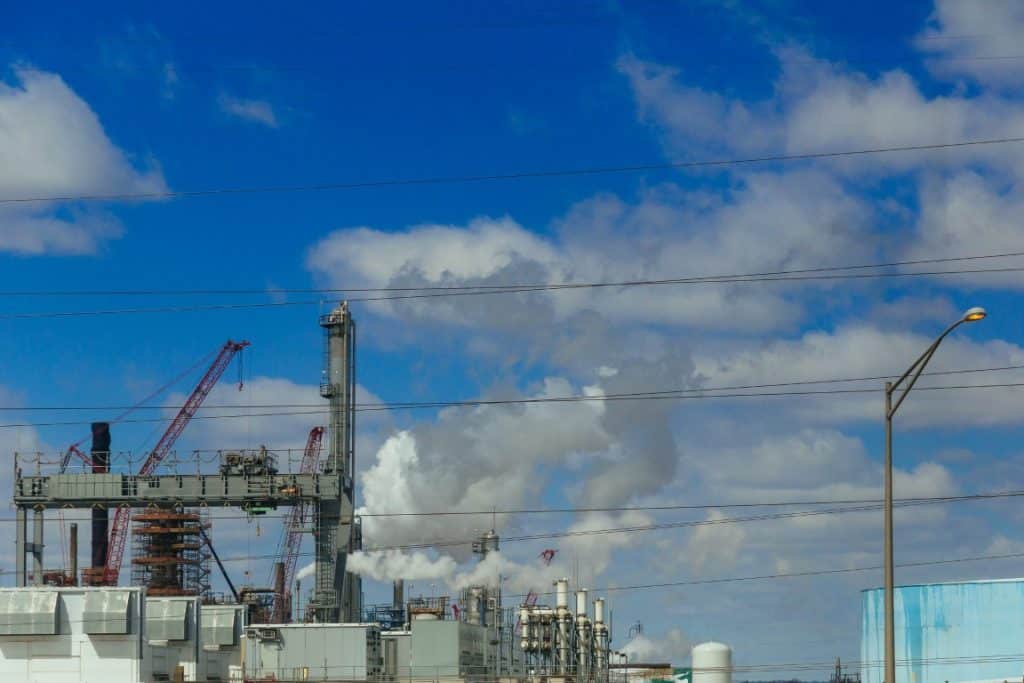
Heavy metal capture in industrial emissions is usually a particle-control and adsorption problem, not a single “one-size-fits-all” filter decision. In Bilbao’s industrial environment, emissions can come from metallurgical operations, chemical processing, automotive paint lines, ceramics, plastics, petrochemical units, waste treatment, and energy systems. The technical challenge is to identify which metals are present, in what physical form, and under what temperature, humidity, and loading conditions they leave the process. Only then can an effective treatment concept be defined.
Heavy metals in air streams are often present as fine particulates, fume, condensed droplets, or compounds attached to dust. In some processes, they may also appear in trace vapor phase depending on temperature and chemistry. That distinction matters because particles are captured with different mechanisms than gaseous pollutants. A system designed only for dust may miss finer fume fractions, while an adsorbent bed alone is not a substitute for proper particulate collection upstream.
For plant teams in Bilbao looking for a practical route to compliance and stable operation, the first step is not choosing a product by name. It is defining the emission profile, understanding the process conditions, and matching the treatment train to the actual contaminant behavior. Bionatur works with industrial gas filtration and adsorption systems for pollutant-specific treatment, including heavy metals where process data supports the design.
What “heavy metal capture” means in industrial emissions
Heavy metals in exhaust gases are not a single pollutant family from an engineering standpoint. The capture method depends on whether the metal is carried by particles, condensed mist, or chemical species in the gas phase. Common process-relevant metals can include lead, cadmium, chromium, nickel, mercury, arsenic, and others, but the design approach depends on the actual emission source and speciation.
In practical terms, there are three broad cases:
- Particle-bound metals: metal-bearing dust or fume captured by filtration, inertial separation, or high-efficiency particulate systems.
- Condensed or aerosolized fractions: tiny droplets or condensed matter that may require coalescence, cooling, or staged removal.
- Vapor-phase species: certain compounds that do not behave like dust and may need adsorption or specific chemical treatment after cooling or pre-cleaning.
This is why the same “metal emission” can demand very different solutions in a furnace, coating oven, reactor vent, or abatement line. In some plants, the main task is capturing particulate matter before it escapes downstream. In others, the gas must first be conditioned so that the target species can be retained by an adsorbent medium or downstream polishing stage.
It is also important to separate metal capture from odor control, acid gas removal, or VOC treatment. A system can be designed to handle several pollutants in series, but each contaminant class has its own chemistry and operating window.
How industrial emissions in Bilbao are typically approached
Bilbao has a concentrated industrial base and a wide variety of emissions profiles. That makes the engineering question more important than the geography itself. A treatment train that works on one site may be unsuitable on another because of humidity, temperature, dust loading, intermittent operation, or changing process chemistry.
For heavy metal control, the usual approach is to work from the source outward:
- Characterize the emission: identify the process, likely metal species, concentration range, gas flow, temperature, moisture, and the presence of dust, acid gases, VOCs, or condensable compounds.
- Control particle loading: use the right upstream collection stage so the adsorbent bed is not overloaded by solids.
- Condition the gas: adjust temperature and humidity when necessary, because adsorption performance can change sharply with process conditions.
- Apply pollutant-specific treatment: use adsorption or other targeted methods only where they are technically justified.
- Plan maintenance and monitoring: define when pressure drop, breakthrough indicators, or process changes should trigger intervention.
For many plants, the best results come from combining equipment rather than forcing a single unit to do everything. For example, a dust collector may protect a downstream adsorbent bed, while the adsorbent handles residual gaseous contaminants or trace metal compounds. That sequence is often more reliable than oversizing one stage and hoping it covers every mechanism.
Bilbao operators also need to consider operational continuity. Metallurgical, ceramic, and chemical lines may not tolerate long shutdowns, so a proposed system should be evaluated not only for capture performance, but also for pressure drop, accessibility, media replacement planning, and how it integrates into the existing ductwork and control strategy.
Adsorption, filtration, and chemical treatment: what each one does
Industrial buyers often use “filter” as a general word, but the treatment mechanisms are different. The distinction matters for proposal review and for realistic expectations.
Filtration of particles and fumes
Filtration removes solids from the gas stream. This is the right mechanism for dust and many metal-bearing particulates. The effectiveness depends on particle size distribution, gas velocity, humidity, dust cohesiveness, and whether the particles are dry, sticky, or condensable. Fine fumes can be more difficult than coarse dust because they behave differently and may pass through systems that are not designed for high-efficiency capture.
Adsorption on a solid adsorbent
Adsorption is a surface phenomenon: molecules or certain compounds adhere to the surface of a solid adsorbent medium. This is not the same as absorption, where a substance enters into the bulk of another material. Adsorption is often used for VOCs, hydrogen sulfide, sulfur compounds, and other target pollutants, and it can also be part of a broader strategy for some metal-related compounds when their chemistry and concentration allow it.
However, adsorption is not universal. A carbon-based or other adsorbent medium may perform well for one contaminant and poorly for another. Temperature, moisture, competing compounds, and residence time all influence performance. That is why a design proposal must be based on measured or well-defined process data, not on a generic promise.
Chemical treatment and staged systems
Some emissions require a chemically active bed or a multistage system. This is especially relevant when the target pollutant is reactive, when humidity is high, or when the gas contains multiple contaminants that interfere with one another. In some industrial settings, a pretreatment step is needed to remove dust or cool the stream before the final polishing stage. The final design depends on whether the metal is actually in particulate form, in vapor phase, or associated with other gases.
For plants already using gas treatment, the key question is not “Can one unit remove heavy metals?” but “Which combination of stages best addresses this specific exhaust stream without creating unnecessary pressure drop, waste, or maintenance complexity?”
What process data is needed for a credible proposal
A serious treatment proposal for heavy metal capture in industrial emissions should start with the right data. Without it, engineering choices become guesses. This is where plant managers and maintenance teams can speed up the process by supplying a clear operating picture.
Useful data for assessment includes:
- Process description: what equipment generates the emission and at which step of production.
- Pollutant profile: known or suspected heavy metals, plus any co-pollutants such as VOCs, acid gases, dust, or odor compounds.
- Gas flow: average and peak flow, and whether operation is continuous or batch-based.
- Temperature and humidity: including fluctuations during start-up, shutdown, and cleaning cycles.
- Particle loading: dust concentration, particle character, and whether the stream carries condensable matter.
- Space and integration constraints: available footprint, duct configuration, fan margins, and installation route.
- Maintenance expectations: access windows, downtime limits, and how spent material should be managed.
- Monitoring requirements: existing instrumentation, alarm philosophy, and whether breakthrough monitoring is already in place.
If the emissions are variable, it is worth explaining how they change. For example, a coating line may show different loading between solvent-heavy batches and cleaning periods. A metal-processing furnace may have distinct peaks during charging, melting, or stabilization. These variations determine whether the treatment system should be sized for the average case, the peak case, or a staged operating mode.
When Bionatur prepares an engineering assessment, the goal is to align the treatment concept with real plant conditions, not with idealized assumptions. That includes defining whether a particulate stage, adsorption stage, or combined solution is appropriate, and whether the project requires media replacement planning or spent material management as part of the service scope.
Where BR350 fits, and where it should be evaluated carefully
BR350 is one of Bionatur’s priority filters, but it should not be assigned to a heavy metal application without verified technical evidence for the specific case. The correct question is not whether BR350 is “for heavy metals” in general, but whether the actual emission profile matches its documented capabilities under the site’s process conditions.
That means the evaluation must check the same essentials as any other industrial gas-treatment project:
- Which heavy metals or metal compounds are present?
- Are they particle-bound, condensable, or vapor-phase?
- What is the gas flow and how does it vary?
- What are the temperature and humidity conditions?
- Is there dust or mist that could overload the adsorbent bed?
- Are other pollutants present that may compete for adsorption sites?
This is especially important in plants where metal emissions coexist with VOCs, acid gases, or high moisture. In such cases, the treatment train may need prefiltration, cooling, or another upstream stage before any adsorbent-based unit is considered. A technically sound proposal should state what the filter is expected to do and what it is not expected to do.
For industrial buyers, that distinction reduces risk. It prevents underspecification, avoids unnecessary media consumption, and makes maintenance planning more realistic. It also helps ensure that replacement intervals, pressure-drop management, and disposal handling are based on actual operating conditions rather than assumptions.
Operational factors that affect capture performance
Heavy metal capture is not only about initial sizing. Day-to-day operating conditions can change performance significantly. A system that works during steady production may struggle during upset conditions if those changes were not anticipated.
Key factors that influence performance include:
- Humidity: water vapor can change adsorption behavior and may cause condensation in cold sections of ducting.
- Temperature: adsorption generally depends on temperature, and some compounds become harder to retain at elevated conditions.
- Dust and fouling: solids can reduce flow paths, increase pressure drop, and shorten service life.
- Competing contaminants: VOCs, sulfur compounds, and acid gases can affect how a medium behaves.
- Intermittent operation: start-stop cycles may create transient peaks that differ from average conditions.
- Maintenance quality: stable seals, correct ducting, and proper instrument calibration matter as much as the filter itself.
Monitoring should focus on process and system indicators, not on subjective checks. Odor is not a reliable safety or performance indicator, and it should not be used to assess whether H2S or other gases are being controlled. In heavy metal systems, the same principle applies: the absence of visible smoke or a noticeable smell does not prove that the emission is adequately captured.
For operators managing multiple pollutant classes, a staged design can be useful. One stage can address solids, another can handle adsorption of targeted gases or trace compounds, and a final polishing stage may provide added protection if the process is variable. The exact sequence depends on the emission profile and the available operating envelope.
Bionatur’s broader industrial gas treatment approach reflects that logic, combining assessment, engineering, supply, installation, commissioning, maintenance, media replacement, and management of spent materials where relevant. More information on that approach is available through its industrial gas treatment solutions.
FAQ
Can activated carbon remove heavy metals from industrial emissions?
Sometimes, but not universally. It depends on the form of the pollutant, the gas temperature, humidity, and whether the metals are present as particles, condensates, or vapor-phase compounds. Activated carbon is one possible adsorbent medium, but it is not a universal solution for all metal emissions.
Is heavy metal capture the same as dust collection?
No. Dust collection removes particles, which may include metal-bearing solids. Heavy metal capture can also involve adsorption or chemical treatment if the target compounds are not purely particulate. Many projects need both mechanisms in sequence.
What data should I prepare before requesting a proposal?
Prepare the process description, expected pollutants, gas flow, temperature, humidity, particle loading, operating schedule, available space, and any maintenance constraints. If you have measurements or lab data, include them. The more complete the process data, the more reliable the engineering proposal will be.
Can BR350 be assumed suitable for heavy metals?
No. BR350 should only be considered after the contaminant form, flow, temperature, humidity, and operating conditions are reviewed against verified technical evidence. Suitability cannot be assumed from the product name or from a general pollutant category.
How should a plant manage spent adsorbent or captured material?
Spent material should be handled according to its contamination profile and the site’s waste management requirements. A proper project should include removal, handling, and disposal or recovery planning as part of the service scope, especially when heavy metals are involved.
If you are evaluating heavy metal capture in Bilbao industrial emissions, the most efficient next step is a technical assessment based on your actual process data and pollutant profile. A well-defined analysis will help determine whether filtration, adsorption, or a staged solution is the right fit for your plant.