


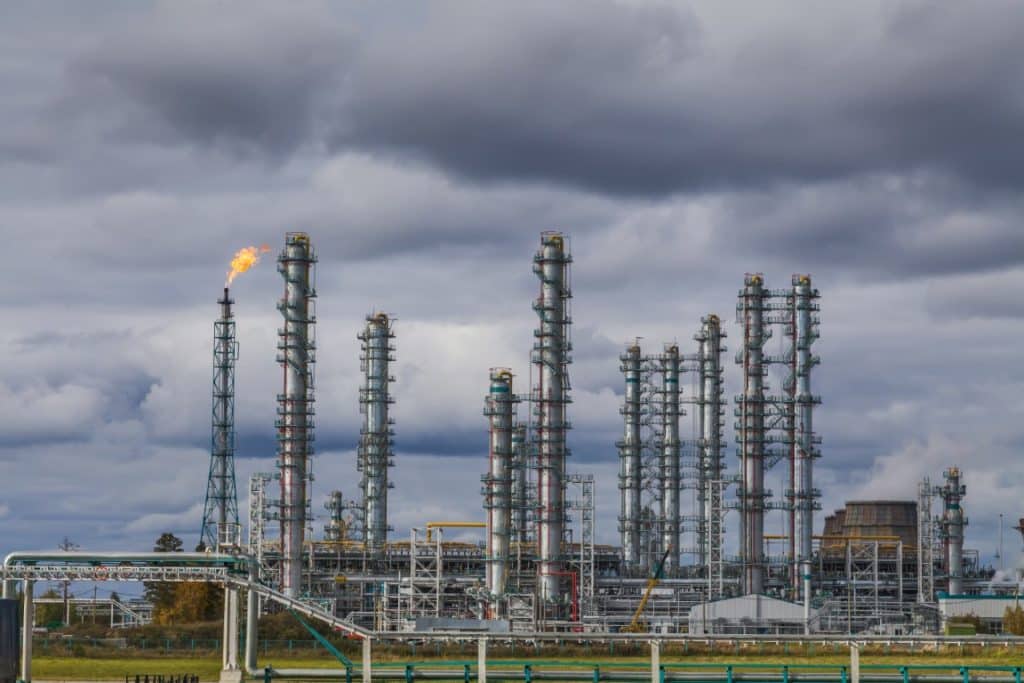
Gas treatment for petrochemical plants in Marseille is usually about controlling a complex mix of vapors and contaminants that can come from storage, transfer, blending, reaction, cleaning and wastewater handling. The right solution depends on what is in the gas stream, how variable it is, and whether the objective is odor control, VOC abatement, acid gas capture, or preparation for downstream treatment.
In practice, petrochemical off-gas is rarely a single-pollutant problem. A stream may contain VOCs, hydrogen sulfide, sulfur dioxide, acid vapors such as HCl or HF, trace organics, and sometimes particulate matter or mists. For this reason, the treatment train must be matched to the actual process conditions rather than to a generic industry label. Adsorption, scrubbing, filtration, and thermal or catalytic options each solve different problems, and they are not interchangeable.
For plant owners, maintenance teams, and environmental managers, the key question is not simply “Which unit should we buy?” but “What process data do we need so the treatment concept is technically sound?” That is the right starting point for any proposal, including projects in Marseille’s industrial and port environment. Bionatur works with industrial gas filtration and pollutant-specific treatment, helping define that process basis before equipment selection.
What petrochemical gas treatment is expected to do
Petrochemical facilities generate several gas-treatment scenarios. Some are continuous, such as process vents or tank breathing gas. Others are intermittent, such as batch reactor vents, loadout emissions, maintenance displacements, or purges. The treatment objective changes with the source.
- Odor control: usually linked to sulfur compounds, some VOCs, and reduced sulfur species.
- VOC treatment: required when hydrocarbons, solvents, or reactive organics are present.
- Acid gas treatment: relevant for HCl, HF, SO2, and related corrosive vapors.
- Hydrogen sulfide control: common in sour streams, wastewater headspaces, and some fuel or process off-gases.
- Protection of downstream equipment: for example, preventing corrosion, fouling, or catalyst poisoning.
It is important to separate gas-phase treatment from particle removal. A filter for dust or aerosols does not necessarily treat dissolved gases, and a gas adsorbent does not remove solids. If both are present, the system may need pre-filtration, mist elimination, or condensate management before the gas treatment stage.
In petrochemical service, the selection also depends on whether the stream is hot or cool, dry or humid, variable or stable, and whether it contains oxygen, water vapor, or condensable hydrocarbons. These factors strongly affect adsorption performance and service life.
Why Marseille projects need a process-specific approach
Marseille’s industrial setting adds practical constraints that are familiar to refineries, chemical plants, storage terminals, and allied process industries. Coastal humidity can influence adsorption behavior, corrosion risk, and the behavior of condensable vapors. Seasonal temperature changes, marine air, and plant layout can also affect how emissions are captured and treated.
That does not mean a local project automatically needs a different technology. It means the proposal should be based on the actual gas composition and operating envelope. Two units with the same nominal flow can require completely different treatment trains if one carries wet sulfur compounds and the other carries intermittent aromatic VOCs.
For this reason, an engineered solution should begin with a proper source review. The most useful question is not “What industry is this?” but “What is the gas, when is it produced, and what else is in the stream?” In the petrochemical sector, the answer may involve more than one emission point, and those points may need separate capture lines before they are combined for treatment.
Where a project involves multiple vents, a central treatment unit can be practical, but only if the combined stream remains within a compatible range for temperature, humidity, flow, and pollutant loading. If not, local treatment at the source may be more reliable.
Adsorption, absorption, and when each method makes sense
Adsorption and absorption are often confused, but they work differently.
Adsorption is the attachment of gas molecules onto the surface of a solid adsorbent medium, such as activated carbon or another engineered sorbent. It is commonly used for VOCs, odor compounds, and some sulfur species, depending on the media and the gas conditions.
Absorption transfers a contaminant into a liquid phase, usually in a scrubber or washing system. This is often used when the target pollutant is highly soluble or reactive in the chosen liquid chemistry.
In petrochemical gas treatment, the choice depends on the pollutant family:
- VOCs and odor compounds: often suited to adsorption, especially at moderate temperatures and controlled humidity.
- Acid gases: may require wet or dry chemical treatment, depending on concentration, moisture, and corrosion constraints.
- Hydrogen sulfide: can be handled by adsorption, oxidation-based media, or other dedicated systems depending on the gas composition.
- High humidity or condensable streams: may need pre-conditioning before adsorption is considered.
Activated carbon is widely used in industrial gas treatment, but it is not a universal solution. Its performance depends on pore structure, impregnation chemistry, gas temperature, relative humidity, and the presence of competing contaminants. In some cases, a carbon grade selected for VOCs will not be appropriate for H2S or acid vapors, and vice versa.
That is why a supplier should ask for process data before proposing a unit. A technically sound recommendation is based on contaminant profile, not on a generic claim.
What data are needed to prepare a credible proposal
Before specifying equipment for a petrochemical gas stream, engineers should define the source conditions clearly. The following checklist is usually the minimum useful basis for a proposal:
- Gas source: vent, tank, reactor, loading point, wastewater headspace, purge, or exhaust.
- Flow profile: continuous, cyclic, batch, intermittent, peak and average flow.
- Temperature: normal, minimum, and maximum operating conditions.
- Humidity and condensables: water vapor, hydrocarbon mist, solvent carryover, or wet gas behavior.
- Contaminants: VOCs, hydrogen sulfide, SO2, HCl, HF, ammonia, siloxanes if relevant, and any known trace organics.
- Concentration range: expected loading, variability, and shock events if they occur.
- Presence of particles or aerosols: dust, droplets, catalyst fines, or corrosive mist.
- Oxygen content: relevant for oxidation-based systems and for safety review.
- Pressure conditions: vacuum, slight overpressure, or atmospheric capture.
- Space and tie-in constraints: footprint, duct routing, access for maintenance, and shutdown windows.
- Operational objective: odor reduction, VOC control, corrosion protection, pre-treatment, or broader emissions management.
This information allows the engineering team to determine whether the stream is suitable for adsorption, absorption, filtration, or a combined process. It also helps avoid oversizing, undersizing, and premature media exhaustion.
In many projects, the proposal stage should also address instrumentation and monitoring. You do not need complex analytics in every case, but the treatment concept should include a practical way to detect breakthrough, pressure drop increase, or abnormal process conditions. That supports planned maintenance and avoids relying on subjective observations.
Where BR350 fits in a petrochemical gas-treatment project
BR350 is Bionatur’s priority filter in this context, but its suitability must still be assessed against the actual gas stream. It should not be assumed to fit a petrochemical service simply because the application is industrial. The correct question is whether the pollutant profile, flow, temperature, humidity, and operating cycle align with the unit’s verified design envelope and documented capabilities.
For a project basis, that means BR350 can be considered only after the process data are reviewed. In some installations, a filter of this type may be part of a larger treatment train that includes pre-filtration, adsorption, and, where needed, additional conditioning steps. In others, a different concept may be more appropriate.
What should be checked before any selection?
- whether the main target is VOCs, hydrogen sulfide, acid vapors, or a mixed stream
- whether the gas contains humidity, mist, or condensables that could reduce performance
- whether the flow is stable or highly variable
- whether the source is continuous or batch-based
- whether the project needs odor control, emissions reduction, or equipment protection
Important: do not assume one carbon-based unit is automatically suitable for every gas. Activated-carbon treatment is selective, and adsorbent choice matters. Some applications may call for impregnated media, while others may need a different adsorbent, a chemical wash, or a combination approach. That decision belongs in the engineering stage, not the catalog stage.
When Bionatur prepares a technical proposal, the objective is to match the treatment concept to real operating conditions, not to force a standard configuration onto an uncertain stream. That is especially important in petrochemical plants, where a small error in gas characterization can affect corrosion control, maintenance frequency, and overall operating cost.
Operation, maintenance, and spent media management
Once installed, a gas-treatment system should be operated as part of the plant’s process control strategy. The maintenance team should know what normal pressure drop, loading trend, and breakthrough indicators look like for the chosen system. This is more reliable than waiting for odor complaints or visible corrosion signs.
Good operation usually focuses on four points:
- Stable inlet conditions: avoid sudden peaks when possible, or provide upstream buffering.
- Condensation control: keep liquid carryover out of the adsorption stage.
- Performance monitoring: use the available indicators to track loading and saturation trends.
- Planned replacement: manage media replacement before performance drops below the required level.
Spent adsorbent or other exhausted treatment material should be handled as an industrial waste stream according to the nature of the contaminants retained. This is part of the complete service scope and should be planned from the beginning, especially when the medium has captured sulfur compounds, solvent vapors, or corrosive substances.
Bionatur’s service model includes assessment, engineering, supply, installation, commissioning, maintenance, media replacement, and management of spent materials. For plants that want a single technical point of contact, that can simplify coordination between process engineering, EHS, and maintenance teams.
It is also worth remembering that gas treatment is not the same as water treatment. Activated-carbon treatment for industrial water and wastewater follows different design rules, contact conditions, and validation requirements. If your project involves wastewater headspace or biogas contaminants, the gas stream should be assessed separately from any liquid-phase treatment.
How to decide between local treatment and a broader system
Some petrochemical sites in Marseille may only need treatment at one vent or one storage area. Others may benefit from a wider network that collects several emission points into a common system. The best option depends on the process layout and the stability of the gas composition.
A local unit is often practical when:
- the source is discrete and clearly defined
- the contaminant profile is stable
- the flow is intermittent and relatively small compared with the rest of the plant
- capturing the gas close to source reduces ducting and condensation issues
A centralized system may be more appropriate when:
- multiple vents produce similar contaminants
- the plant wants easier maintenance access
- the gas can be safely and consistently routed to one treatment point
- the combined flow remains compatible with the selected treatment technology
For mixed petrochemical emissions, a staged concept is often the safest engineering answer. For example, a pre-separation step may remove particles or mist, followed by adsorption for residual vapors or odor compounds. The exact arrangement depends on the data, not on a fixed template.
When Bionatur is asked to assess a project, the goal is to define the treatment basis first and the equipment second. That approach reduces guesswork and improves the chance that the final system will be maintainable, operable, and technically aligned with the process.
For more background on the available treatment approaches, see the industrial gas treatment solutions overview.
FAQ
Can one gas-treatment system handle VOCs and hydrogen sulfide together?
Sometimes, but not automatically. Mixed streams need careful assessment because VOCs, hydrogen sulfide, humidity, and temperature all affect media selection and service life. A combined solution may be possible, but it should be based on measured or well-defined process data.
Is activated carbon always the right choice for petrochemical odors?
No. Activated carbon is useful in many odor-control applications, but the right adsorbent depends on the contaminants and operating conditions. Some streams need impregnation, pre-treatment, or a different technology altogether.
What is the difference between removing contaminants from biogas and enriching methane?
Contaminant removal improves gas cleanliness by reducing compounds such as hydrogen sulfide, siloxanes, or other impurities. Methane enrichment is a different objective that separates or concentrates methane itself. A project focused on contaminant removal should not be described as methane enrichment unless that process is specifically designed and documented.
How do I know when filter media needs replacement?
Replacement should be based on the system’s monitoring indicators, operating history, and supplier guidance for the specific application. Do not rely on smell alone, and do not open the unit unnecessarily. The maintenance plan should define the practical signals that indicate saturation or performance decline.
What should I prepare before requesting a proposal?
Provide the gas source, flow profile, temperature, humidity, contaminant list, concentration range, and any particle or condensate issues. The more precise the process data, the more reliable the technical proposal will be.
If you are planning gas treatment for a petrochemical plant in Marseille, the fastest route to a suitable concept is a technical assessment based on real process conditions. Bionatur can help review the stream data and define the right treatment approach.